T H E M O R O N T E S T
An Operational Philosophy
for Systems That Survive Humans.
The discipline applied to every system before it ships. Three laws. One question. The line between architecture and dependency.
The Question
Will this work the first time
without instructions,
without heroics,
and without complexity?
If the answer is no, the system has not been designed. It has been assembled. And assembly is how dependency gets in.
The Three Laws
The architecture every system must satisfy.
Every system must satisfy three laws of architecture before it ships: users feel like geniuses, no instructions are needed, and the system is highly personal.
Law One
Users Feel Like Geniuses.
Law One says the users of a well-built system feel like geniuses, not like the problem. The system makes the person using it look capable. Not because the person is brilliant. Because the system carries the complexity so they do not have to. If the user feels stupid, the system has failed the test. The user is not the problem. The architecture is.
Law Two
No Instructions Needed.
Law Two says a system that passes the Moron Test needs no instructions to be used correctly. If the system requires a training video, a manual, or a 22-step Google Doc, it has failed. The system should be the documentation. The next step should be obvious from where the person is standing. Instructions are a confession that the design did not finish.
Law Three
Highly Personal.
Law Three says every system must be highly personal to the people who actually use it. The system adapts to how the team actually works. Not the other way around. If the team has to work around the system, the system is decoration. The best architecture meets people where they are and removes friction without asking permission.
What the Test Prevents
The Dependency Cascade
The Dependency Cascade is the four-stage path from complexity to fragility inside a founder-led company. Complexity creates dependency. Dependency creates fragility. The cascade is invisible because each stage looks like something else.
Complexity
Complexity is the stage where tools accumulate and steps multiply. Sophistication is mistaken for capability.
Dependency
Dependency is the stage where specific people become required to operate the system. The dependency looks like expertise.
Compensation
Compensation is the stage where the team builds workarounds around the system. Side spreadsheets. Tribal knowledge. The compensation looks like teamwork.
Fragility
Fragility is the stage where the company stalls when any single thread is pulled. The fragility looks like growing pains.
That is the cascade the Moron Test prevents.
The Audit
Does Your Company Pass the Moron Test?
This audit shows whether your company passes the Moron Test in five questions, scored out of 25.
Five questions. Two minutes. One truth.
The Moron Test Audit
Five questions. Two minutes. One truth. Does your company pass the Moron Test?
Question 1 of 5
When a new employee starts, how long before they can do their job without needing you?
Question 2 of 5
If you disappeared for two weeks, what stops moving?
Question 3 of 5
How many times last month did your company need you instead of needing the system?
Question 4 of 5
Do your systems adapt to how your team actually works, or does your team work around the systems?
Question 5 of 5
After using your systems, does your team feel more capable or more dependent on you?
Or download the Executive Audit Scorecard and run The Moron Test on any process, product, team, or system in your organization. →
Failures
The Hall of Failed Systems
The Hall of Failed Systems collects one pinned confession and nine anonymized systems that failed the Moron Test.
Theory is cheap. Scar tissue is expensive.
The CRM Nobody Used
Law 1 ViolatedThe CRM nobody used had 47 required fields. Only the founder knew how to use it correctly. Reporting theater instead of an operating system.
The Onboarding System That Required the Founder
Law 2 ViolatedThe onboarding system was a 22-step Google Doc, 8 months out of date. The founder WAS the instructions, every time.
The Scheduling System Built for Robots
Law 3 ViolatedThe scheduling system was technically perfect and designed for desktop. Used in the field on phones. Nobody used it.
The Book
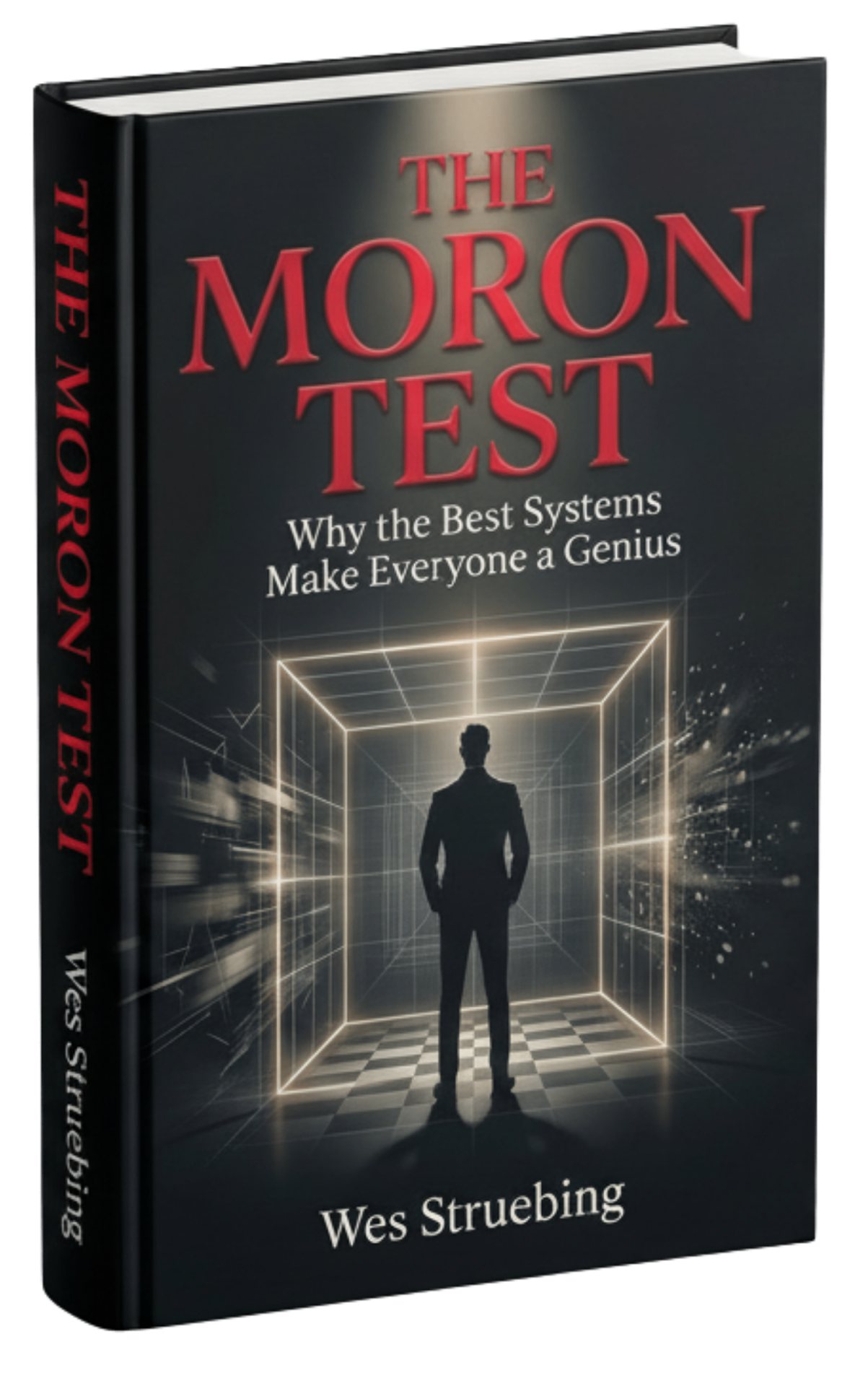
The Moron Test: Why the Best Systems Make Everyone a Genius.
The Moron Test book by Wes Struebing explains why the best systems make everyone a genius. The philosophy, fully expressed. Run The Moron Test on your own organization with the Executive Scorecard — or read Chapter 1 free.
The people who fail the Moron Test are the builders, not the users.
By Wes Struebing · Last updated