The Founder Should Not Be the Operating System.
Most founder-led companies are accidentally built around one employee.
The founder.
I fix that. Forty years of building, breaking, and rebuilding the operating architecture that lets companies run without the person at the top holding every thread.
FOUNDER. OPERATOR. SYSTEMS ARCHITECT.
The Pattern
Your revenue looks great.
Your operation doesn't feel great.
You have 14 logins, six vendors who do not talk to each other, a team that waits on you for decisions you should not have to make, and a calendar that looks like someone lost a bet.
If your company stops moving when you leave the room, you do not own a company. You own a dependency loop.
Somewhere between $3M and $30M, the founder becomes the glue. The glue becomes the bottleneck. And the bottleneck quietly erodes your margin, your team, and your credibility with clients who expect consistency you cannot guarantee unless you are personally in the room.
That is not chaos. Not yet.
It is fragmentation. And fragmentation is expensive.
If you want a quick fix, a magic dashboard, or a consultant who tells you what you want to hear, I am not your guy. I work with founders who are honest about what is broken and ready to build something that will survive them.
Doctrine
Most companies do not fail because people are lazy.
They fail because complexity compounds. Systems fragment. Accountability diffuses. The founder becomes the glue.
And growth hides structural weakness until scale exposes it.
Clarity beats complexity. Every time.
Operational friction is measurable. If you can measure it, you can fix it.
Systems should survive normal humans on normal days.
Software should reduce dependency, not create it.
Most companies think communication is culture. It is infrastructure.
The founder should eventually become optional to daily execution.
That is the work.
A Letter to the Founder Still Holding Everything Together
I know what it costs to be the person everything depends on.
You built something real. You carried it when nobody else would. You made decisions at midnight that nobody thanked you for. You held payroll in your chest like a second heartbeat.
And somewhere along the way, the thing you built started needing you for everything.
Every exception. Every approval. Every client relationship. Every fire.
Your team is good. Your product is good. Your revenue is real. But none of it runs without you in the room. And you are starting to wonder how long you can keep being the room.
I have been that founder.
I built load and called it growth. I bought six tools and none of them talked to each other. I could not take a week off without the phone ringing. I was the operating system of my own company, and I did not know it until I almost broke.
I built my way out of it.
I have also been the founder who almost did not survive his own company.
I built my way out of it.
That is the experience I bring.
I work with founders who want to build something that runs without them holding every thread.
The Shift
What Changes When You Have the Right Design
The right design moves your company off the founder and onto a system your team runs, in three phases: Discovery, Architecture, and Deployment.
I've spent four decades in logistics, freight, and operations. I've built AI-driven pricing systems. I've designed operating architectures for companies stuck between growth and structure. And I wrote the book on why most systems fail — it's called The Moron Test.
Discovery
Discovery is the first phase: a diagnostic of every place your company still depends on you. We map your current chaos — the bottlenecks, the dependencies, the decisions only you can make. This is the diagnostic that reveals where the system breaks.
Architecture
Architecture is the second phase, where the structure that replaces the founder gets designed. We design your operating system — decision frameworks, accountability structures, and communication protocols that let your team execute without you.
Deployment
Deployment is the third phase, where the system moves from design into daily execution. We install the system into your company. Your team learns to run it. You step back from operations and into strategy.
Platform Lanes
Three Platforms. Three Distinct Capabilities. No Overlap.
Each of these three platforms covers a distinct freight capability, and no two of them overlap. I don't overlap lanes. I complete them.
NexMuv
NexMuv delivers AI-driven instant pricing for local movers to monetize interstate demand. No van line compliance. No margin sacrifice. Full operator control.
CRST Specialized Transportation
CRST Specialized Transportation provides asset-backed precision for high-value, high-risk freight. Healthcare, tech, FF&E, government. White-glove handling with real operational accountability.
GlobalTranz (WWEX Group)
GlobalTranz (WWEX Group) is a multimodal enterprise 3PL. Scalable brokerage infrastructure, carrier depth, technology-enabled visibility. LTL, truckload, intermodal, cross-border, final mile.
Results
What Founders Say
What founders say comes back to one shift: the company stops running through the founder.
“Wes didn't just give us a strategy — he gave us a system. For the first time in six years, I took two weeks off and revenue went up.”
James K.
CEO, Industrial Services Co.
“We went from 47 Slack messages before lunch to a team that runs itself. The operating system changed everything.”
Sarah M.
Founder, SaaS Platform
“I was the bottleneck and I couldn't see it. The Discovery phase was uncomfortable. The results were undeniable.”
David R.
Managing Partner, PE-Backed Portfolio
Frameworks
The Eight Frameworks for Scalable Control.
These eight frameworks give a founder-led company scalable control, so decisions, hand-offs and exceptions stop routing through the founder.
01
The Dependency Audit
The Dependency Audit maps every thread that runs through the founder.
02
The Decision Ladder
The Decision Ladder pushes decisions down to where the information lives.
03
The Communication Spine
The Communication Spine treats communication as infrastructure, not culture.
04
The Friction Ledger
The Friction Ledger measures operational drag in dollars and minutes.
05
The Hand-Off Protocol
The Hand-Off Protocol makes work survive the person doing it.
06
The Exception Engine
The Exception Engine productizes what used to require the founder.
07
The System Score
The System Score gives a continuous read on whether the architecture holds.
08
The Survivability Test
The Survivability Test asks one question: could a normal employee, on a normal day, execute this?
The Founder Dependency Index
How Much of This Runs Through You?
The Founder Dependency Index measures how much of your company runs through you, in three questions and about 60 seconds. Three questions. A score. A bucket. An honest read on where you sit on the dependency curve.
The Founder Dependency Index
Three questions. Sixty seconds. One number that tells you how dependent your company is on the person at the top.
Question 1 of 3
In the last 30 days, how many operational decisions required you personally?
Question 2 of 3
In the last 30 days, how many times did your company need you instead of needing the system?
Question 3 of 3
How many of your top 10 client relationships would be at risk if you were unreachable for two weeks?
Founder Notes
Field notes from the work.
Founder Notes are field notes from the work of building companies that run without the founder holding every thread.
Doctrine
Busy Is Not a Business Model
Busy is not a business model: if your calendar is the proof your company works, the company does not work yet.
Field Note
The Glue Tax
The glue tax is simple: every dollar you save by being the glue, you pay back in margin and sleep.
Framework
Designing the Hand-Off
Designing the hand-off matters because work that cannot be handed off is work the company cannot scale.
“Busy is not a business model.”
“If every decision requires the founder, you do not have a company. You have a dependency.”
“You did not build growth. You built load.”
Speaking
Talks for Operator Audiences.
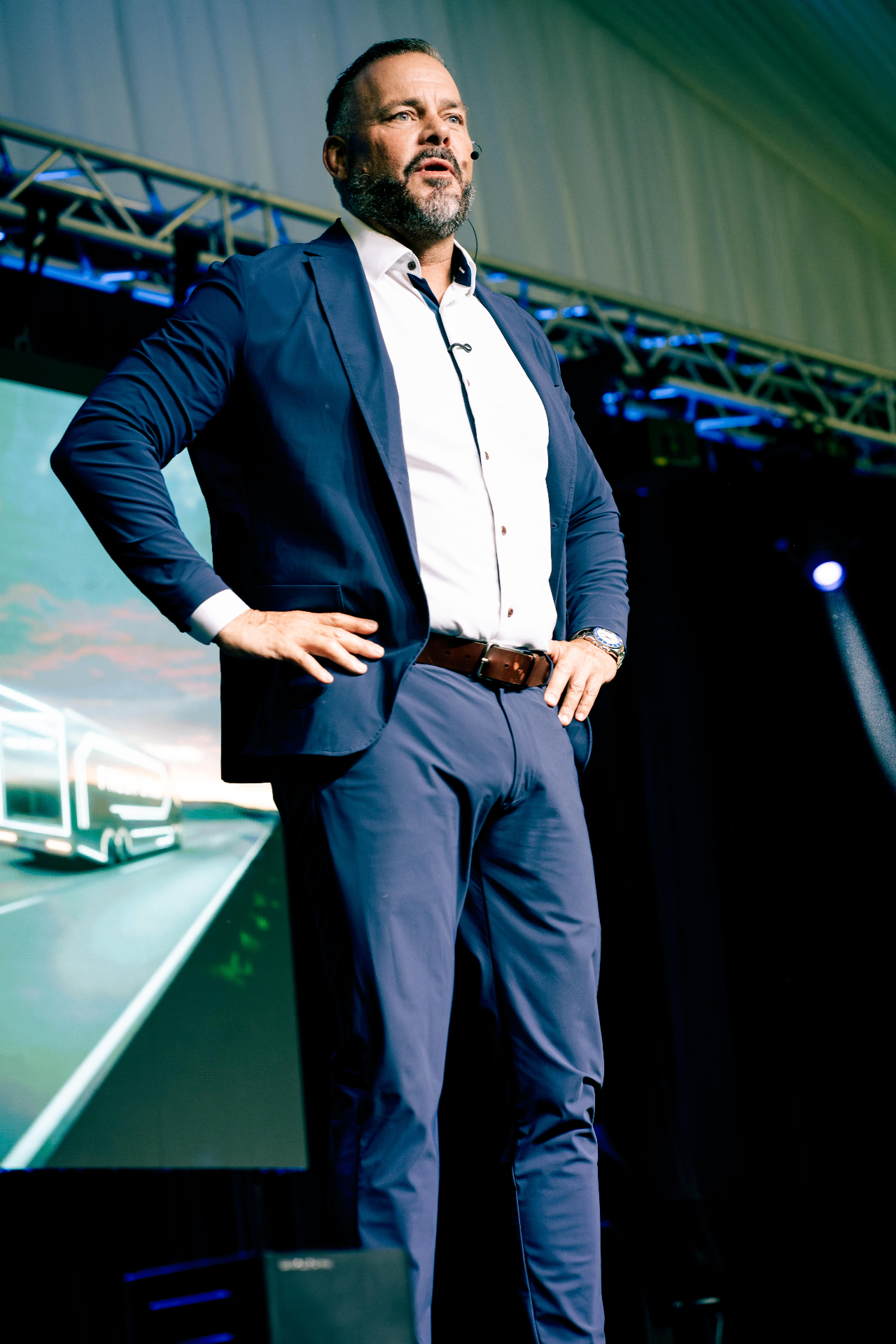
My talks for operator audiences are keynotes, panels, and workshops on founder dependency, operational doctrine, and the architecture of companies that scale without burning their founder. The keynote runs 45–60 minutes. Topics and reel landing soon.
Inquire About SpeakingQuestions
Frequently Asked Questions About Founder Dependency
Who is Wes Struebing?
Wes Struebing is a third-generation operator and systems architect with 40 years inside logistics, freight, operations and founder-led companies. His grandfather founded Westlake Moving Systems in 1934. He is the author of The Moron Test and the host of the Move or Be Moved podcast.
What is founder dependency?
Founder dependency is when a company is accidentally built around one employee: the founder. Decisions, approvals, client relationships and operating knowledge all run through one person, so the company stops moving when the founder leaves the room. That is a dependency loop, not a company.
Which companies does Wes Struebing work with?
Wes Struebing advises founder-led companies between $5M and $100M in revenue where the founder has become the glue and the glue has become the bottleneck. He works with founders who are honest about what is broken and ready to build something that will survive them, not with anyone looking for a quick fix or a magic dashboard.
How does an engagement with Wes Struebing work?
An engagement runs in three phases: Discovery, Architecture and Deployment. Discovery maps the bottlenecks, dependencies and decisions only the founder can make. Architecture designs the operating system: decision frameworks, accountability structures and communication protocols. Deployment installs that system so the team runs it and the founder steps back from operations into strategy.
See how the three phases work →What happens on a discovery call?
A discovery call is a 30-minute conversation with no pitch and no deck. It covers what is broken in your operation and whether Wes can help fix it. If it is not a fit, he will tell you and point you toward someone who is. Calls are booked on the contact page.
What is the Founder Dependency Index?
The Founder Dependency Index is a three-question assessment that measures how dependent your company is on you. It returns a score and a bucket in about 60 seconds, giving an honest read on where you sit on the dependency curve.
Take the Founder Dependency Index →What is The Moron Test?
The Moron Test is Wes Struebing's book and operational philosophy for systems that survive normal humans on normal days. It is built on three laws and one question, and it explains why most systems fail. The introduction to the book is a free download with no email required.
Read about The Moron Test →Does Wes Struebing speak at events?
Wes Struebing speaks in three formats: 45 to 60 minute keynotes, half-day or full-day workshops, and closed-door private briefings for leadership teams, boards and operator groups. Topics include founder dependency, margin versus fragmentation and the operating system of a scalable company.
Speaking topics and formats →Let's Talk
I have been the founder who built load and called it growth.
I have been the operator who could not take a week off.
I have been the guy who bought six tools and none of them talked to each other.
I built my way out of it.
That is the system I install.
30 minutes. No pitch. No deck. Just an honest conversation about what is broken and whether I can help fix it.
If it is not a fit, I will tell you. And I will point you toward someone who is.
By Wes Struebing · Last updated